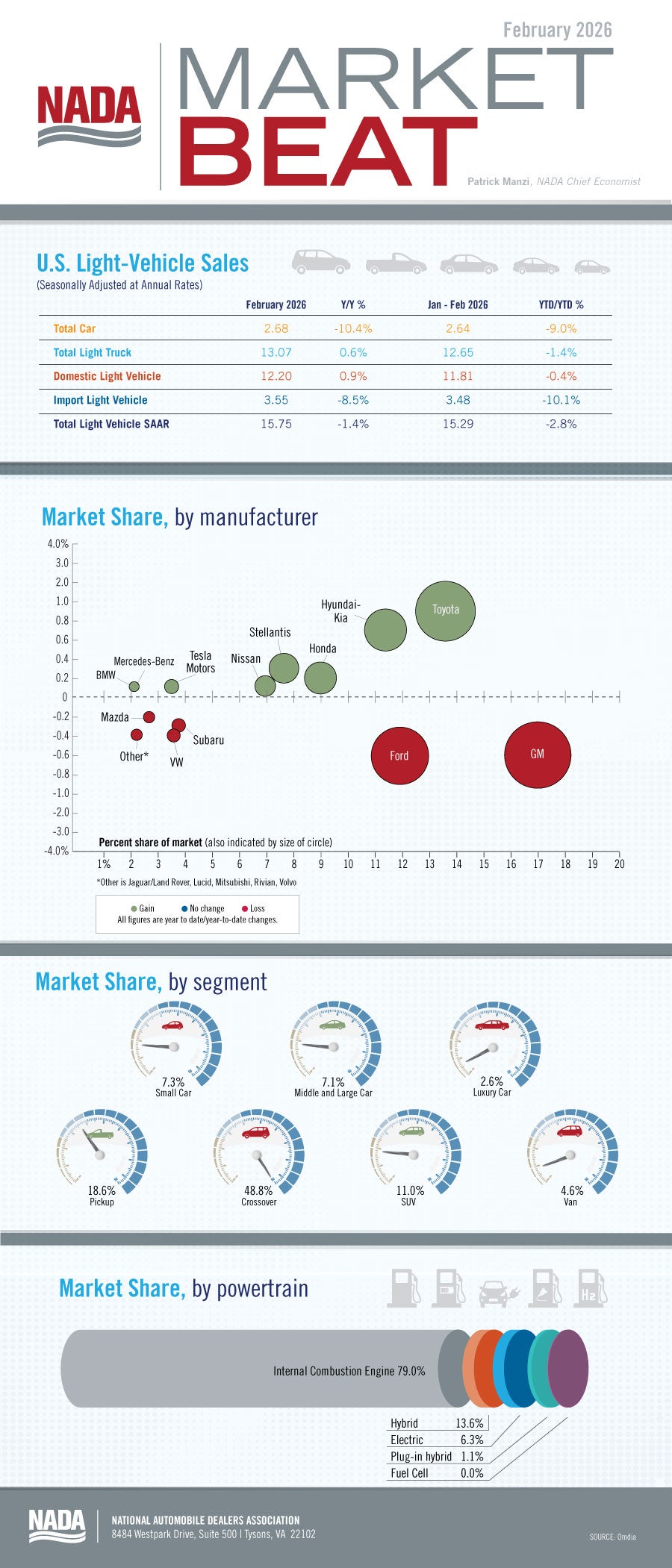






New light-vehicle sales in February reached a SAAR of 15.8 million units, down 1.4% year-over-year. While the sales pace improved compared to January 2026, significant winter storms continued into February and affected sales somewhat in the mid-Atlantic and Northeast regions. The sales pace is expected to accelerate in March as competition between OEMs heats up in the last month of the quarter.
Battery electric vehicle (BEV) market share totaled 6.3% year-to-date through February, down 1.5 percentage points compared to the same period last year. BEV market share has yet to return to levels seen in 2025, before the expiration of federal BEV tax credits. And this is despite OEMs allocating significantly more incentive spending to their BEV products. According to JD Power, the average discount on BEVs should total $10,356 in February, while discounts on non-EVs should total $3,085. Meanwhile, sales of conventional hybrids have performed well, with market share totaling 13.6% year-to-date in February, an increase of 1.5 percentage points year-over-year.
Discussions about vehicle affordability have permeated the auto industry as consumers cope with rising payments. According to JD Power, the average monthly payment in February should total $811, up $32 year-over-year. One strategy some consumers have been using to manage higher payments is extending their loan terms. JD Power notes that more consumers are choosing 84-month loans, which should represent 12.7% of financed sales in February, up from 7.7% in February 2025.
While the Iran conflict is unlikely to have significant impacts on the auto industry in the short term, there certainly are risks depending on the duration of fighting in the region. The conflict could result in higher energy prices, which can lead to increased prices for production inputs and potential supply disruptions.
So far this year average tax refunds are up roughly 10%, according to the Tax Foundation. Because of higher refunds, we expect a bigger-than-usual boost this spring to used-vehicle demand, as well as potentially a small boost to new-vehicle sales. Looking ahead to the end of the year, we expect new light-vehicle sales will total 16.0 million units in 2026.