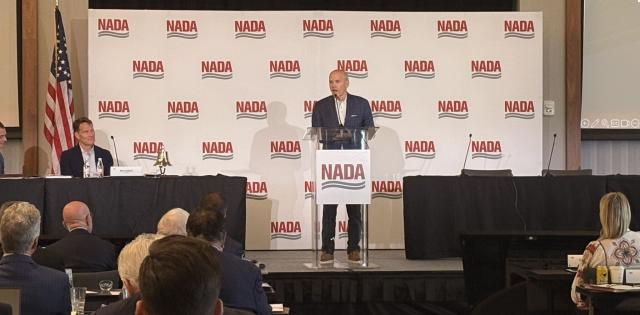

LAS VEGAS (Feb. 5, 2026) – Dealers looking for practical AI guidance packed the Live Stage on Thursday morning at NADA Show, where Ross Tinkham, vice president and general manager of automotive for Podium, stressed that the industry has moved past experimenting with AI and into a phase where a well-planned strategy is crucial.
Podium offers AI solutions for automotive sales and service, through innovations like Jerry, an AI “employee” that gives dealerships customizable, brand-aligned capabilities. Jerry answers calls, works leads and books directly for dealerships. According to Tinkham, 25% of dealerships in the United States now use Jerry.
The title of the presentation — “Stop Settling for Bad AI” — hinted at Tinkham’s broad overview of AI in the retail automotive segment, as he highlighted how dealers can drive revenue across sales and service with full-platform AI.
His central message about AI: adoption is no longer optional. “If you’re not using AI, you should be starting today,” Tinkham told attendees.
Dealership usage is expanding quickly, according to Tinkham — especially in variable operations such as sales communications, lead response and appointment setting. Tinkham said about 48% of dealerships were already using AI in 2025 and predicted adoption would surpass 70% by the end of 2026.
But he cautioned that not all AI deployments deliver the results that businesses need. Early dealership tools functioned largely as scripted chatbots, while modern systems now aim to manage real conversations across the entire customer lifecycle.
Effective AI today “doesn’t just answer your questions,” he explained. “It gauges emotion. It's more than just answering questions at a surface level; [it] can really understand the context of a conversation.”
That shift — from scripted automation to more responsive, conversational engagement — is the difference between simply installing AI and actually improving performance, he said.
Tips for Making the Most of AI
Tinkham encourages dealers to have a clear vision of their goals when determining an AI strategy. “What are we are looking to solve or convert? Are we trying to improve our response time to customers? What is the outcome of the bigger response then?”
Finding the most appropriate AI services is also important, Tinkham noted. “You’ve got to anchor yourself to a partner… not just a vendor,” he said.
A recurring theme throughout the session was that implementation determines success more than the model itself — in other words, dealers should approach AI as an operational program rather than a plug-in feature. This approach makes training especially important, Tinkham noted. “What will it take to win with AI in 2026?” he asked. “This is really the most important thing that we've discussed today: it’s the trainability of your agent, not just the fact that it was trained.”
That includes customization through ongoing feedback and monitoring. “Customization is incredibly important,” Tinkham said. “If you can't do that, it's not going to work the way you really want it to for your stores. The way in which you customize the agent is actually really important … being able to give real-time feedback, to see that response, be updated in real time; all these things are certainly available today.”
Tinkham summarized effective dealership AI around four operational requirements:
- Conversion: turning conversations into appointments … and, ultimately, sales
- Coverage: responding 24/7 across text and voice
- Consistency: uniform messaging and follow-up
- Customization: matching dealership processes and brand voice
Without those elements, he said, stores risk adding technology costs without measurable return.
Tinkham also noted that the “next wave” of AI lives in the service lane. “By the end of 2026, over half of dealerships will be using AI in fixed ops, with another 29% planning on implementing in the next two to three years,” he said.
The takeaway from Thursday’s session was clear: the question is no longer whether whether dealerships should adopt AI, but how they can best take a strategic, thoughtful approach and find the best ways for it to fit a dealership’s needs and improve the customer experience.
Visit Podium at Booth 4353SW for an AI performance review.