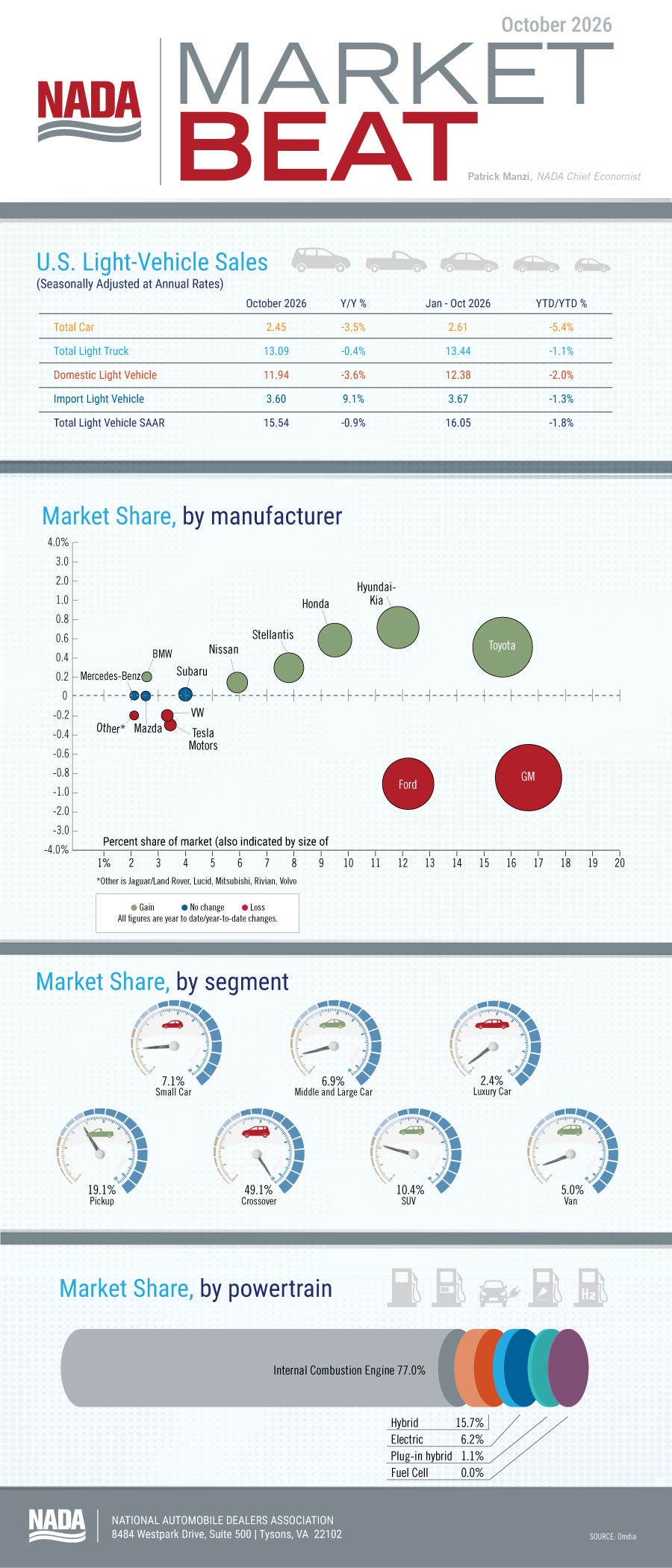




New light-vehicle sales in October 2026 reached a SAAR of 15.54 million units, down 0.9% compared to October 2025. The year-to-date SAAR through 10 months of the year was 16.05 million units, down 1.8% compared to the same period in 2025. Given the pace of sales so far this year, we expect to meet and likely exceed our 2026 full-year sales forecast of 16.0 million units.
As has been the case for the past year, conventional hybrid powered vehicles continue to be in high demand. Year-to-date, conventional hybrid vehicles have accounted for 15.7% of all new-vehicles sold, an increase of 3.1 percentage points year over year. On dealer lots, conventional hybrid vehicles take half the time to sell compared to vehicles with a traditional internal combustion engine (ICE). In September 2025, JD Power data showed that on average a conventional hybrid vehicle took 26 days to turn versus 53 days for an ICE vehicle. We expect the final data for October to show similar trends. Battery electric vehicle sales (BEV) continue to post year-over-year declines in market share. Through 10 months of the year, BEV sales accounted for just 6.2% of all new light-vehicle sales, down 2.1 percentage points year over year.
New-vehicle affordability remains a challenge for the industry, and those affordability pressures did not let up in October. JD Power estimates the average monthly payment for a new-vehicle finance contract will total $823 in October, an increase of 2.6% year over year. Borrowing costs also continue to rise, with the average interest rate on a new-vehicle finance contract increasing by 19 basis points year over year to 6.81% in October.
Affordability will continue to be a challenge in 2027. Medium- and long-term US Treasury yields remain elevated, and markets expect the Fed to hike the Fed Funds Rate by an additional 25 basis points at its final meeting of the year in December. Both these macro developments point to higher borrowing costs coming soon. Still, new-vehicle demand has been robust, and we don’t expect consumers to pull back in the final two months of the year.