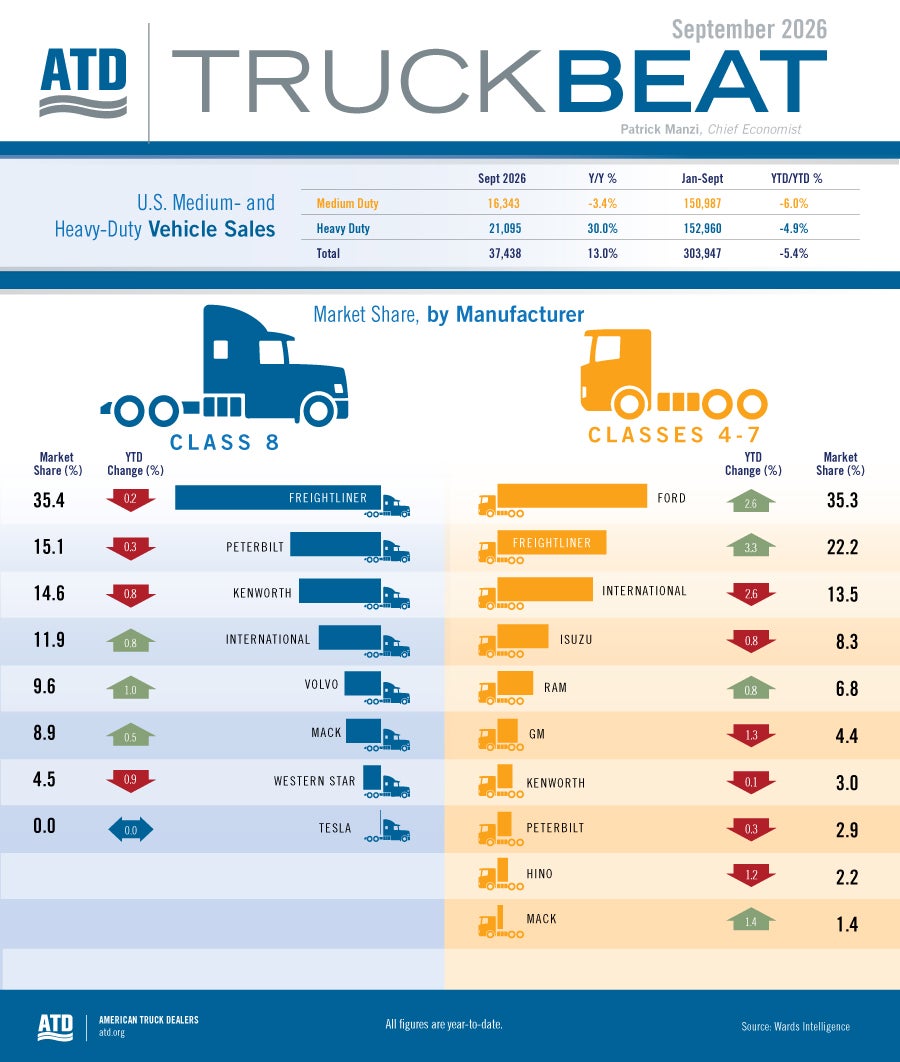






New commercial truck sales in September 2026 totaled 37,438, up 13% compared to September 2025. Through three quarters of the year, new commercial truck sales totaled 303,947, down 5.4% compared to the same period last year. Both medium- and heavy-duty truck sales were down year over year through the third quarter despite a solid sales month for Class 8 trucks in September.
After strong order activity over the summer, preliminary orders for new Class 8 trucks declined 9.5% year over year, totaling 18,700 units in September, ACT Research says. Orders cooled after a strong start to the year, and order counts may be limited by some OEMs not fully opening orders for 2027. ACT also estimates that Class 5-7 truck orders were up 27% year over year to 20,200 units.
The freight market recovered earlier this year after a nearly four-year freight recession. Freight demand has been strong from firms building out AI infrastructure across the supply chain, while consumer demand has remained relatively flat. Freight rates have been pushed higher by a lack of trucking supply. The AI buildout will be a tailwind for freight for the foreseeable future.
A significant headwind for trucking firms has been the war in Iran and its impact on diesel prices. Oil prices have increased significantly, but diesel prices have increased even more as the world deals with a refining capacity shortage. Fighting in the Middle East and Ukrainian strikes in Russia have knocked out significant refining capacity. US refiners have moved to fill the gaps, but even with US refineries running at near full capacity, diesel prices have topped $6 per gallon on average across the country with some regions seeing prices above $7 per gallon. Diesel prices will be a significant challenge in the short- to medium-term.
We still await the final EPA 2027 emissions rules, which will impact pricing and order volumes of model year 2027 equipment. We expect more clarity soon. For 2026, we expect medium-duty sales of 220,000 units and heavy-duty truck sales of 230,000 units, both of which would be positive increases compared to 2025.